
Retrobatch evaluation: Effortless-designed approach workflows for impression processing
 [ad_1]
 At a glance
Expert’s Rating
Most effective Price ranges Now: Retrobatch
If your work—or fun—involves robot-like repetitive actions taken on illustrations or photos, Retrobatch can set the automation in your workflow and depart you time to tackle far more artistic jobs. The application, in development throughout 20 years, allows you build processing workflows for very simple operations, like introducing a border and shifting resolution, up as a result of substantial chained sets of transformations applying rules that enable you choose just one or far more paths for an picture to acquire.
That power is managed via visible connections, producing a flowchart-like set of linked nodes. Nodes are specialised, like making use of an influence or resizing an impression. Each node can have a number of inputs or outputs. A common movement reads illustrations or photos from a supply (a folder, a assortment dialog, the Images library, and many others.), passes them as a result of processing and decision-creating measures, and then writes the illustrations or photos to the exact same or distinctive spots. That middle part is exactly where the motion comes about.
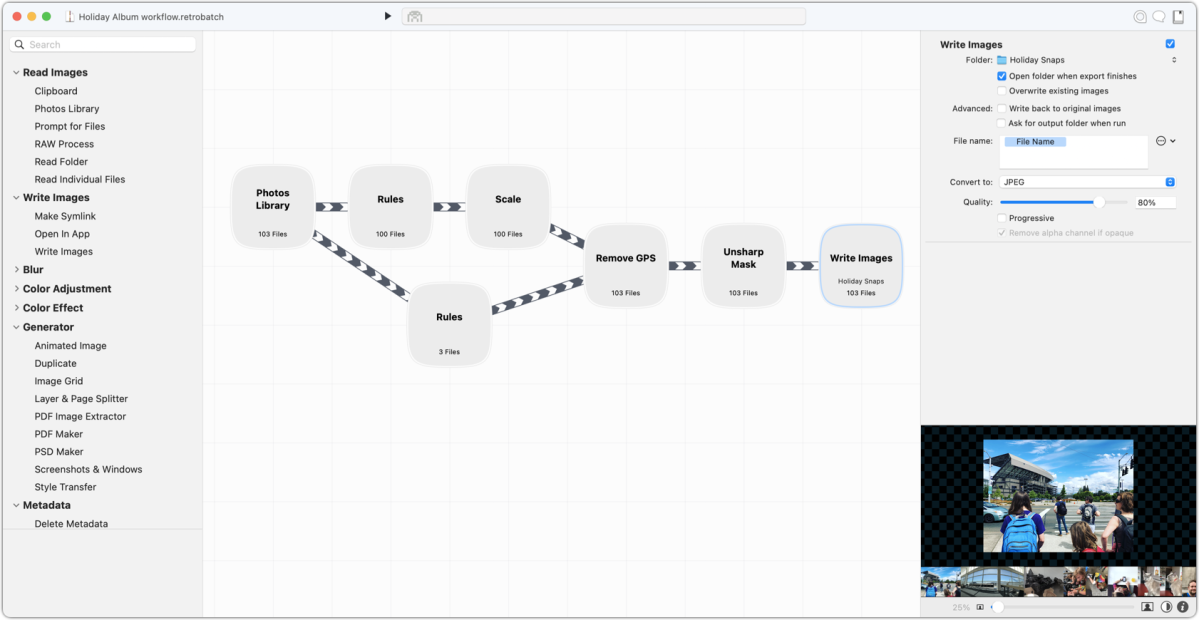
To create a workflow, you generate a new Retrobatch doc and drag elements from a listing on the remaining-hand side, divided into types. For instance, if you want to method a bunch of holiday photos you’d presently set into an album in Shots to add to a social community or photograph-sharing provider, building confident you are not outputting enormous files, you could produce a workflow that appears to be like:
- Browse Photos album for your holiday trip
- Scale documents above two megapixels to no much more than two megapixels
- Eliminate GPS information
- Utilize an unsharp mask (a common procedure to punch up an picture)
- Help save to a new folder
As you function, Retrobatch performs qualifications “preflighting,” which tests functions and calculates the number of illustrations or photos that will be processed by every single action, giving a depend in the node. That lets you preview how your regulations will use to your resource pictures.
Retrobatch involves nodes for adding watermarks, modifying color areas, generating numerous versions of illustrations or photos at diverse sizing factors for web-sites, exporting to a unique file format, making the equal of call sheets, introducing borders and consequences, and making use of requirements to generate an “instant alpha,” or mask utilised usually for qualifications transparency. This checklist just scratches the floor.
As with many apps that use a graphical method to developing sequencing, you may well get frustrated when back links concerning nodes really do not get created the way you anticipate. Fortunately, I can supply a basic idea to overcome that: In Retrobatch > Tastes > Standard, examine “Manual connections with management drag.”
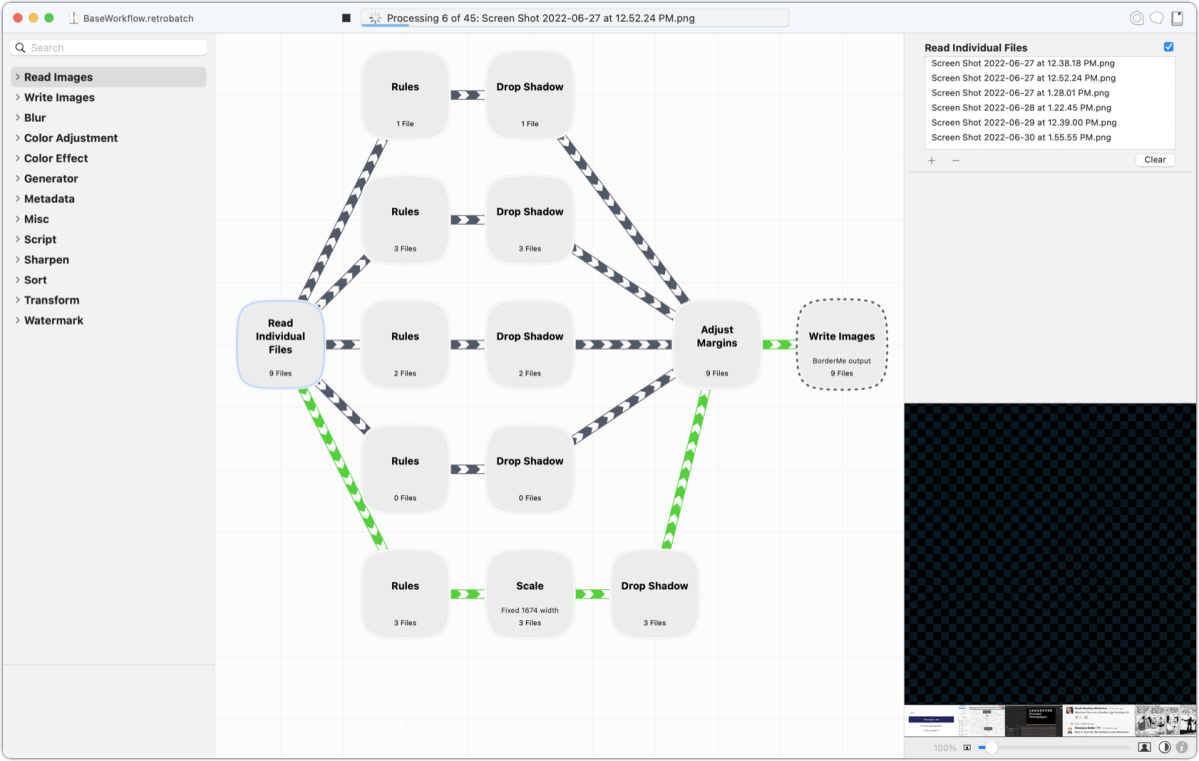
Though Retrobatch arrives with many procedures of choosing photographs to course of action, you can also use Folder Actions to result in workflows using a simple AppleScript recipe. Then just drag photographs onto a Finder folder icon to carry out typical functions.
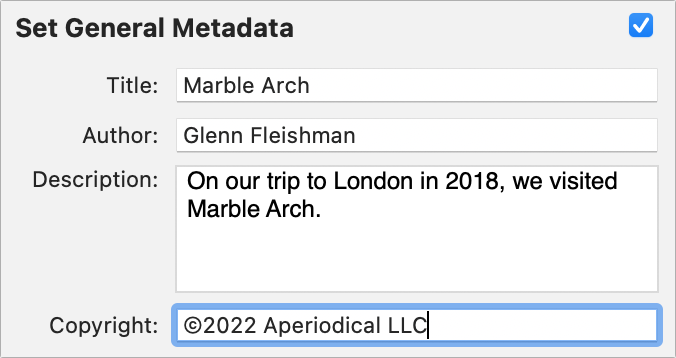
There are only two noteworthy missing pieces in Retrobatch. Very first, the app supplies granular command more than introducing and eradicating image metadata employing Clear away Distinct Metadata and Established Distinct Metadata options—but only for one fields or, with Established Typical Metadata, title, writer, description, and copyright. Remaining capable to implement a common locale or take out, established, or change a listing of metadata fields at at the time would be beneficial.
Second, the workflow nodes always have the exact same titles. Even though you can incorporate a Workflow Notes node in the Retrobatch doc to jot down what the sequence does, I’d choose a way to rename nodes or annotate them, so labels seem in the most important view that reminds me what I have created.
Retrobatch comes in a standard and pro variation, with the latter together with scripting, PDF, image classification employing machine discovering, and other additional highly developed capabilities. Having said that, the rate variance is just $20: Retrobatch is $29.99 Retrobatch Professional is $49.99. Both variations present a 14-day free trial. The applications help macOS 10.12 and later on.
For any individual who spends additional than an hour a week massaging photographs into a individual shape, Retrobatch will fork out for alone practically right away.
With the robust resurgence of the Mac in new several years, we want to rejoice the applications we use and that audience advise to make the most of your macOS expertise. Mac Gems highlights fantastic nuggets of Mac application, applications that have a high utility, have a sharp emphasis on a limited set of complications to remedy, and are normally created by an individual or tiny firm. Continue to be tuned for weekly updates, and send out your ideas to the Mac Gems Twitter feed (@macgems).
[ad_2] https://g3box.org/news/tech/retrobatch-evaluation-effortless-designed-approach-workflows-for-impression-processing/?feed_id=1854&_unique_id=62c81af5c3978

0 comments:
Post a Comment